
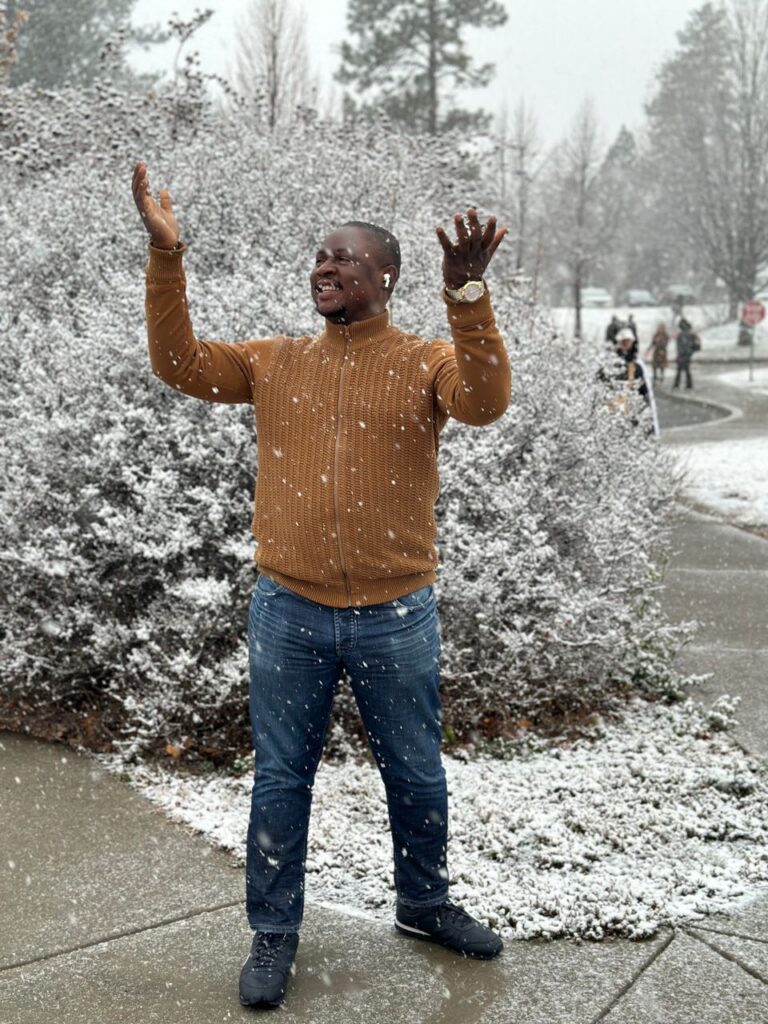
My Frist Snow in Canada. Picture Taken on November 22nd, 2024.
Throughout my Master of Arts in Human Rights and Social Justice program at Thompson Rivers University, my understanding of human rights has evolved from a general moral and legal awareness into a deeply critical, interdisciplinary, and action-oriented perspective. The coursework not only expanded my theoretical understanding of rights and justice but also challenged me to reconsider how human rights are lived, contested, and protected in diverse social, cultural, and political contexts.
Courses such as “Foundations of Human Rights and Social Justice” introduced me to the philosophical and historical roots of human rights, from Enlightenment liberalism to postcolonial critiques. This provided a solid foundation to understand how universal rights discourses emerged, as well as their limitations in addressing systemic inequalities. I learnt that Human Rights are founded on fundamental principles such as decency, fairness, respect and equality. They safeguard your daily life regardless of who you are, where you live, or how you choose to live.
In “Indigenous Ways of Knowing” coursework, I encountered an alternative epistemological framework that profoundly reshaped my thinking about human dignity, relationality, and justice. Engaging with Indigenous perspectives helped me see that human rights cannot be separated from collective rights, land, and cultural survival. This course deepened my appreciation for decolonial approaches and the need to indigenize human rights practices in Canada and beyond.
Similarly, in the fall of 2025, one of the courses that I took is titled, “Risk, Place, and Social Justice in a Turbulent World,” in my final paper, I researched on “Housing Insecurity in Canada: Are International Students Convenient Scapegoats?” This research enabled me to apply human rights principles to real-world issues. This practical engagement bridged theory and lived experience, strengthening my capacity for critical analysis, advocacy, and Human rights research.
Moreover, exposure to testimonies of Holocaust survivors and discussions around the slogan “Never Again” in one my courses titled, “Genocide in the 20th Century”, made me reflect on the fragility of memory and the dangers of selective empathy. It taught me that remembering past atrocities must serve as a universal moral commitment to prevent oppression in all its forms, rather than being weaponized for political justification.
Overall, my coursework transformed my understanding of human rights from abstract ideals into living principles that demand constant reflection, dialogue, and accountability. I have come to see human rights not merely as a legal framework, but as a dynamic and evolving practice rooted in solidarity, intersectionality, and the pursuit of justice for all.